Showing posts with label Alan Moore. Show all posts

Friday, November 22, 2013

Watchmen & The Origins Of The Graphic Novel

Magic Words: The Extraordinary Life Of Alan Moore (Aurum Press, 2013)
by Lance Parkin
LANCE PARKIN:
(from Magic Words: The Extraordinary Life Of Alan Moore, 2013)
The first graphic novels were usually fairly slim albums, self-published by the artists, advertised in comics fanzines and hawked at conventions. But by the early eighties, Marvel and DC had got in on the act with original graphic novels that often used existing characters, like the X-Men book God Loves, Man Kills or Jack Kirby's Fourth World book The Hunger Dogs. But these were all new stories. Even series like Camelot 3000 and Frank Miller's Ronin, the comics closest in form to Watchmen, were never intended to be collected in one book. If you wanted to read them, you bought the back issues. Comic shops dedicated most of their floorspace to the section where their customers could catch up on comics they had missed. Fans might have to pay a premium for 'hot' comics they'd been foolish enough to ignore on original publication, but that was all part of the game. Ronin was published in 1983, but the collected version was not released until 1987, thanks to intense interest in Miller's work after The Dark Knight Returns. It would be fifteen years before Camelot 3000 was collected. There were digest-sizes reprints and 'graphic albums' - usually oversized replicas of the first appearance of popular characters or a repackaging of movie adaptations - but there weren't any books which collected recent comics.

Alan Moore would reasonably have expected the twelve issues of Watchmen to be published and for that to be that; when he signed the contract, there was not a single precedent to suggest otherwise. He, Gibbons and DC all fully expected that within a few years all rights would revert to the creators. Even as the early issues of Watchmen went on sale, however, the game was changing. One catalyst was Dave Sim, creator and self-publisher of Cerebus The Aardvark (1977-2004) a series which had transformed from a pastiche of Conan and Howard The Duck comics into a literate, complex discussion of religion and politics. Sim had been publishing slim collections of old material for a number of years, but found that keeping supply matched to demand was a challenge, and his printing bills were expensive. In 1985, DC began negotiating to publish graphic novels of the Cerebus back catalogue, and offered Sim $100,000 and a 10% share in royalties and merchandise. This looked like an extraordinarily good deal for Sim, but he was unhappy at having to sign over so much control of his intellectual property. He came up with the alternative of self-publishing thick 'phone-book' paperbacks collecting twenty-five issues at a time, which would be far easier to keep in print. Sim published a 512-page volume, High Society, in June 1986, and by cutting out every possible middleman he had earned himself $150,000 within weeks. He would become a champion of self-publishing, putting his money where his mouth was by supporting dozens of ventures.

The corporate publishers, though, could learn the lesson of Cerebus: there was a market for collections of recent comics, and DC, would soon reap the rewards.

Thursday, November 14, 2013

Objectivist Spider-Ham

The Objectivist Spider-Ham (2009)
Art by Dave Sim
ALAN MOORE:
(from Comic Book Artist #9, Twomorrows, 2000)
...Despite the fact that Steve Ditko was obviously a hero to the hippies with his psychedelic Dr. Strange work and for the teen angst of Spider-Man, Ditko's politics were obviously very different from those fans. His views were apparent through his portrayals of Mr. A and the protesters or beatniks that occasionally surfaced in his other work. I think this article was the first to actually point out that, yes, Steve Ditko did have a very right-wing agenda (which of course, he's completely entitled to), but at the time, it was quite interesting, and that probably led to me portraying [Watchmen character] Rorschach as an extremely right-wing character...

...I can look at Salvador Dali's work and marvel at it, despite the fact that I believe that Dali was probably a completely disgusting human being [laughter] and borderline fascist, but that doesn't detract from the genius of his artwork. With Steve Ditko, I at least felt that though Steve Ditko's political agenda was very different to mine, Steve Ditko had a political agenda, and that in some ways set him above most of his contemporaries. During the '60s, I learned pretty quickly about the sources of Steve Ditko's ideas, and I realized very early on that he was very fond of the writing of Ayn Rand...

...I had to look at The Fountainhead. I have to say I found Ayn Rand's philosophy laughable. It was a "white supremacist dreams of the master race," burnt in an early-20th century form. Her ideas didn't really appeal to me, but they seemed to be the kind of ideas that people would espouse, people who might secretly believe themselves to be part of the elite, and not part of the excluded majority. I would basically disagree with all of Ditko's ideas, but he has to be given credit for expressing these political ideas. I believe some feminists regard Dave Sim in much the same light; they might disagree with everything he says, but at least there is some sort of sexual-political debate going on there. So I've got respect for Ditko...

...Steve Ditko is completely at the other end of the political spectrum from me. I wouldn't say that I was far left in terms of Communism, but I am an anarchist, which is 180° away from Steve Ditko's position. But I have a great deal of respect for the man, and certainly respect for his artwork, and the fact that there's something about his uncompromising attitude that I have a great deal of sympathy with. It's just that the things I wouldn't compromise about or that he wouldn't compromise about are probably very different.

Even if they have morals you don't agree with, a person with strong moral code is a person who has a big advantage in today's world.

Monday, October 7, 2013

Limited Edition Beer Steins

Cerebus #224 (November 1997)
Art by Dave Sim & Gerhard
DAVE SIM:
(from a conversation with Alan Moore in Dialogue From Hell, Cerebus #217, April 1997)
...When I visited that Scots bastard Eddie Campbell (it really does take one to know one), we were both into our cups one afternoon and he started in on your scripts. You know, he would just get Anne to go through them and underline what had to be in the panel and bollocks to all your windy exposition. Having read a number of your scripts, I pointed out that you were always very good about letting the artist know that a lot of the description was for your benefit and could be used or not used as it suited him or her (hi, Melinda). Well, Eddie was having none of it and goes into his studio and roots out one of your scripts and begins a dramatic reading of one of your lengthier descriptions. Or undramatic reading, rather, by way of emphasising his own point. So, Eddie’s sitting in the kitchen droning your description, and I’m sitting on the postage-stamp-sized back porch (Campbell Enter-prises being a smoke-free environment) facing into the kitchen. Now, having just read a hundred or so pages of From Hell in photocopy form, I am as immersed in 1888 London as I’m ever likely to be, anyway, and I start disappearing mentally and psychically into your description. With Eddie droning and droning it begins to envelop me like an incantation, and I begin rocking back and forth on the white plastic kitchen chair I’m sitting on, thoroughly inside of your word-rhythms and invocations, simultaneously resentful of the sneer on the old Campbell mug and anticipating the good-natured or not-so-good-natured (both of us being Scots bastards) row that is imminent as a result of our divergent reactions. Something had to give, and it turned out to be the chair I was sitting on. One leg snaps off pitching me over backwards and hurling one of Eddie’s prized, limited-edition Guinness glass steins out of my hand - the stein bounces neatly down a half-dozen stairs before smashing into a million fragments. Of course, I’m apologising all over the place, and Eddie is crestfallen. They don’t make the glass steins anymore, do I have any idea how many Guinness he had to drink to get each one of them (as if THAT was some torturous ordeal for him), etc., etc. He had had six of them (six being the number of the Lovers in the tarot —and what else, metaphorically speaking, is the even-handed balance of a writer and artist than a literary/artistic love affair?), and now he had five (the number of the Hierophant, interpreter of arcane wisdom, which in its negative aspect is epitomised by the imposition of said interpretation without the accompanying wisdom). Served him right, I actually thought. Served him bloody well right...

Monday, August 5, 2013

The Corporate Pyramid

Editorial Cartoon in WAP! #6 (1988)
by Dave Sim

DAVE SIM:
(from the Comics Forum interview, 1993)
...If you picture a multinational corporation as a pyramid, coming down there's a ragged bottom of middle-level bureaucrats, and dangling from the end of one of the strands is an editor. Down below him, trying to reach up, is the creator. An editor is paid a Manhattan salary. Those people leave tips in restaurants bigger than what creators work for. This is why the reward for one of the top creators is always to offer them an editorial position. They're struck dumb when they say to someone like Alan Moore, "We'd like to make you an editor, an overseer of a line of comic books," and the reply is "No, I just want to write them."

You have to understand that these people have no credibility. Neil Gaiman has no credibility. Frank Miller has no credibility. They are a profit center. They are a prestigious thing to have around... The company has to feel at every point that what they have given you is a magnanimous gesture on their part. They cannot have the tail wagging the dog. There's a reason why it's the Vertigo Tour and not the Neil Gaiman Tour. DC owns Vertigo, they don't own Neil. They've already been burned with Frank Miller and Alan Moore. They didn't own them but the made them into superstars and then had them walk away. They won't make the same mistake again. They know what they own, what they control, and what they don't. I'm not, and refuse to be, a lapdog begging for scraps. Whatever level you get to in the comic-book field, that's what you are. Once you sign the contract, you get what you get. It's the company that decides it. You don't, your agent doesn't, your lawyer doesn't, your publicist doesn't. You're talking Time Warner. You are a tiny speck in the middle of their magnifying glass and that's all you can be. If you see it any other way, you're kidding yourself...

On his My Rant Blog, Steve Bissette details the content and historical context of the 9 issues of WAP!, "the forgotten activist pro-zine", published between 1988-1989, which included contributions from Alan Moore, Frank Miller, Dave Sim and other comics creators.
WAP! (Words and Pictures), a newsletter for comics freelance artists and writers.”), arrived sometime in early 1988. - See more at: http://srbissette.com/?p=17233#sthash.A3D4feoS.dpuf

Friday, August 2, 2013

The 'Last Promethea Story' Explained

Promethea (DC Comics, 1999-2004)
by Alan Moore & J.H. Williams III
GABRIEL McCANN:
(by email, 29 July 2013)
I was just wondering if you would be interested in posting Dave Sim's Last Promethea Story (which is really just a serious of fictional letters he made up) when I was once upon a time thinking of turning my online Promethea annotations into a book of some kind, like Jess Nevins' one on the League of Extraordinary Gentlemen. It never happened, but one of the people I did ask to contribute something to it was Dave and he was the only one to reply back extremely promptly, not with a sketch which is what I was hoping for, but with the letters. He recently mailed me a copy of it again. I lost the original when I moved house. Dave wrote a nice note on the title page "Feel free to lose these again" :-)

The Promethea letters have never been published anywhere as far as I know so it would be great for fans to find out all about them from your site. Not sure how well they would hold up as you need to have read at least the first Promethea book to understand some of the injokes he makes in the letters. I still have to ask Dave if he eventually finished all 32 issues of Promethea and what he thought of the whole thing once it was all over. I think he must have written the piece when it was only about half published.
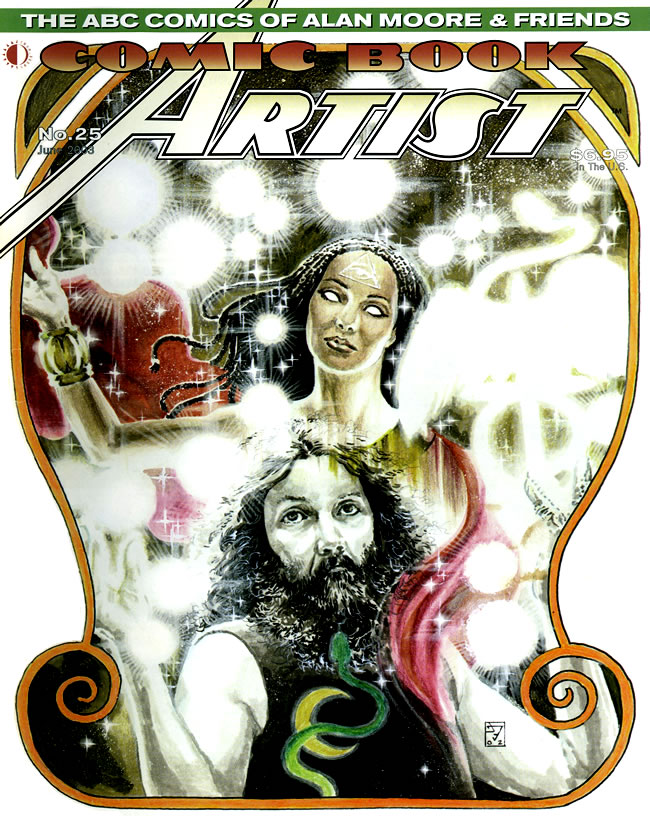
Comic Book Artist #25 (Twomorrows, June 2003)
Art by J.H. Williams III
DAVE SIM:
(by fax, 25 February 2013)
Promethea: No it wasn't my "cup of tea" but I think it's necessary if you want to be a well-rounded person (and I do want to be a well-rounded person) to read things that you know you're going to disagree with or that comes from an area of experience with which you aren't compatible. When I was at "T" and "M"'s place in Texas, "T" turned me onto John Layman's CHEW. And frankly told me that John Layman is still fuming about how badly I screwed up CEREBUS, you know, ten years later. Well, it's nothing personal I don't think -- it's going to happen. What are the odds that ANY creative work is going to satisfy even half of its audience when it runs for 26 years? Very poor. I don't resent it, I feel bad that I have -- or had -- a lot of John Layman's money and he didn't end up getting full value out of it. I can't say that I ENJOYED CHEW. It's pretty grim stuff when your lead character eats dead flesh to gain clear insight. I mean, in a way it's resonant with the Johnannie Jesus' "I am the bread of life": unless you eat my flesh, etc. You can just imagine how that impacted on Orthodox Jewish ears 2000 years ago. And "T" and I had a pretty rousing discussion about it when he got home from work. And I had "T" take a publicity shot of me beside his pool CHEWing on a corner of the trade. I thought John would get a kick out of it. But I do get to the point where I wonder if this is just gross-out horror for its own sake. And he's doing a LONG, LONG story so having got caught up on it, I still don't know. It's not an easy story to write, it's very popular and it's very long ALREADY. I don't regret reading it. "What a waste of my valuable time when I should be writing  STRANGE DEATH". I'll probably wait until it's done and buy the whole thing for myself and read it then. THAT category of fan. Same with LOCKE & KEY. I read the first two volumes at "T"s place and then asked Chris at IDW to send me the rest. It's very well done. It's intricately plotted, the dialogue is very sharp, the characters well delineated, the art is UNBELIEVABLY good, but it... really isn't my thing. But I was very happy to do a variant cover for the last issue when Chris asked. And I did a very quite, sweet moment in the middle of this intricately plotted inferno. I remember reading that scene and thinking, "If Chris asks me to do a pin-up for this, I know what I'm doing."

A cover? Hey even better. And I did it as Ditko's cover to SPIDER-MAN 29. I'll explain all that when IDW actually releases it.

PROMETHEA isn't really in that category. Alan got about as gross and mean-spirited as he was going to get with THE KILLING JOKE and SWAMP THING. That's the impression I have, I haven't read everything he's written. Even the gross-out parts of FROM HELL are pretty sedate. At the same time it's advocacy of a point of view. PROMETHEA, I mean. What a goddess is. What a goddess would be like, high and low, many levels and layers, intricately interwoven. He didn't sell me on it, but you can't help but admire the sheer writing ability that went into it. This didn't just land on the page like this, and there's a great deal of authenticity to it. Which, from where I sit, isn't the same as validity or Validity. But it's an interesting experience -- definitely not a waste of time -- to subject myself to it. I disagree with this. WHY do I disagree with this? It's nutritious if it gets you thinking about the exalted level of ability that Alan seems to hit effortlessly when he's firing on all cylinders as I think he was on PROMETHEA.

This is getting complicated considering my tribute story is like five pages long. Oh, well.

It was a weird juxtaposition. I heard from Gabriel McCann in Australia who sends me stuff and has sent me stuff. I have a MARX BROTHERS ENCYCLOPEDIA A to Z he sent me which I don't use all the time, but when you need it, you need it. And he was doing something with PROMETHEA. I forget. I call it his PROMEATHEA zine and he corrected me the last time he wrote to me (and sent me an autographed copy of Monty Python vet Michael Palin's HEMINGWAY ADVENTURE.) But I forget what the story is. But, you know, THERE! That's the kind of stuff that he does. And I tried to think of something quick and interesting I could do and send to him. He might even have asked for a drawing of PROMETHEA. Well, no, that isn't quick and easy. And I had just read the first book or the second book (it might even have been John Layman who sent it to me, come to think of it), so I was pretty savvy about the concepts and knew where to look for a gap that I could do a little five page novelty story around. Fitting into Alan's continuity. Alan doesn't strike me as someone who's going to, you know, sue you for doing his character without asking so it's always nice not to have to worry about that.

It was really me going back the other way. A way of applauding something that I disagreed with but had nothing but the deepest admiration for. Hoping I can so the same thing to Alan that Alan just did to me. Hope he would read it and think it wasn't a waste of his time (hopefully far from it).

Gabriel participated in the HARDtalk Virtual Tour and at one point I asked him if he ever published the story. And no, he had LOST it. I wrote it in like, 2005. Well, you know, it's got to be around here SOMEWHERE. I wouldn't send Gabriel the only copy. I was working on computer. I still don't know how to find things on my MacBook. Stuff Sandeep uploaded for me, but I'm gradually figuring it out (gum, gum, gum). I usually find something and then can't remember how I got there so I have to wait until I'm looking for something else, which is what happened.

Probably not "your cup of tea" but then, sometimes that's what it's all about.

There you go, and intro longer than the story.

Gerald Summers' Last Promethea Story


(Many thanks to Gabriel McCann and Margaret Liss for making this post possible.)

Thursday, July 25, 2013

Eddie Campbell's From Hell Companion

From Hell Companion
by Eddie Campbell & Alan Moore
(Top Shelf/Knockabout, July 2013)
EDDIE CAMPBELL:
(from the introduction to From Hell Companion, 2013)
...Watchmen had been a continuous celebration for two year by [1988]. But Alan had fallen out with the publisher, DC Comics, and was determined to reinvent his career in a way that did not involve corporate manipulations. His first moves consisted of, on the one hand, self-published Big Numbers with Bill Sienkiewicz as illustrator, and on the other he lined up  a second to be serialized in Taboo, the new horror anthology published  by fellow discontent Steve Bissette. This was to be a complex retelling of the story of the Whitechapel muders of 1888. Alan and Steve set their minds to choosing an artist for the job. Like Alan, I had already appeared in the first issue of Taboo (Nov 1988) with a short story, The Pyjama Girl. I had also worked with Alan once before when I illustrated Globetrotting for Agoraphobics (in Knockabout, 1985). But my work was otherwise about the contemporary and the quotidian. Horror was  not my thing and I must have seemed an odd choice to illustrate the doings of the most infamous serial killer in history, Jack The Riper. The rational, as Steve explained, was that "It was essential that the artist not be seduced by the violence in the tale..."

And so it was off and running. From Hell appeared in Taboo for six issues of that publication, and then assembled and completed in ten volumes of its own title between 1991 and August 1996, published by Tundra and then Kitchen Sink Press. An eleventh volume, The Dance Of The Gull Catchers, being an appendix, was added two years later in September 1998. The complete work was first published all in one book, under my own Eddie Campbell Comics imprint (all of our previous publishers having by then gone out of business), in the last month of the old millennium, December 1999. It has been continuously in print since then in about twenty languages, still increasing as I write this. When I say continuously, I'm ignoring a one-year hiatus after the printer of our US edition went bankrupt. Considering the collapses of publishers, distributors and a printer, one has to marvel that the complete book got published at all.

DAVE SIM:
(from a fax, 16 July 2013)
I don't know if Eddie forgot or never knew that I was the one who financed TABOO at first, so I'm technically FROM HELL's first publisher. Bissette vouchered all the jobs and I cut him a cheque and paid the printing bill... It really is quite a good book: exhaustive coverage. I hope he sells a bunch. I'm assuming that FROM HELL the graphic novel has survived FROM HELL the movie in a way that WATCHMEN didn't.

Sunday, July 7, 2013

Alan Moore: Jimmy's End

Young 'Alan Moore' Cerebus (2012)
Sketch by Dave Sim

Alan Moore and Mitch Jenkins have launched a Kickstarter campaign to help fund the making of the final film in the Jimmy’s End cycle - His Heavy Heart. To learn more about the project and get involved visit the campaign page: Kickstarter: His Heavy Heart.

"Everybody out there is supporting the Alan Moore & Mitch Jenkins Kickstarter, aren't they?... G'wan g'wan."
Neil Gaiman

Sunday, April 7, 2013

Alan Moore's Marvelman/Miracleman

Miracleman #1 (Eclipse Comics, 1985)
By Alan Moore & Gary Leach
FOLLOWING CEREBUS:
(from 'The Controversy Over Copyrights' in Following Cerebus #3, 2005)
Alan Moore and Gary Leach created Marvelman for Warrior magazine in the UK in 1982. A modern updating of the beloved fifties series (obviously inspired by Captain Marvel), the new version became extremely popular. In 1985 Eclipse Comics began reprinting the stories in colour, also to wide acclaim. The series ended after twenty-four issues, with new stories written by Neil Gaiman. The character's name changed to Miracleman in the Eclipse editions because of complaints from Marvel Comics, thus souring Moore on ever working for Marvel. When Eclipse went bankrupt, Todd McFarlane bought the assets - which did not include publishing rights, but only tangible property. Eventually he transferred this to Gaiman, but soon afterward filed for a trademark on the name. Gaiman sued, and the controversy is still mired among the lawyers.

DAVE SIM:
(from 'Dave Sim On Parody &Copyright' in Following Cerebus #3, 2005)
...in light of what I've just said about all the ins and outs of trademark and copyright, and where I think there's a certain validity, and where I think it's all just "smoke and mirrors" make-work projects for lawyers, I find the Miracleman situation particularly disheartening. Essentially Miracleman is the changed name of Marvelman who was a very half-assed knock-off of Captain Marvel, which was published in England. The problem seems to stem from the fact that the iconic costume has great sentimental resonance for English comic book creators of Alan Moore and Neil Gaiman's generation. This was the reason Alan Moore wanted to write a revived Marvelman, and this was the reason that Neil Gaiman was pleased to be asked to follow him on the book and thrilled that he was given Alan's share of Miracleman as part of his compensation and eager to get whatever part of Miracleman Todd McFarlane acquired out of the Eclipse bankruptcy auction.

When I became aware of the situation that was brewing, I contacted Neil directly and Todd indirectly and suggested that the whole thing could be headed off at the pass by just agreeing to make Miracleman the same as Cerebus is, an unprotected trademark. It seemed very sensible to me. Neil already had all of the Miracleman negatives from Todd, so he could print his own work and Alan's in one big Miracleman trade paperback, and Todd could do Miracleman statues and hockey sweaters and baseball caps and whatever else Todd was interested in. Miracleman would be protected on the same basis Cerebus is. Anyone would be free to do a Miracleman comic book, but they would be competing with the Alan Moore / Neil Gaiman / Mark Buckingham version if they did so. I think it would be as unlikely that someone would try to do that as it is that someone would try doing a Watchman sequel if Watchmen were an unprotected trademark.

Unfortunately - unfortunately, to my way of thinking - Neil adopted the viewpoint that everything had been set in motion, and there was no turning back, rather like the troop trains at the start of World War I. He has set up the "Marvels & Miracles Foundation" to determine who actually owns Miracleman and, to me, he has thereby walked into the oldest lawyer trick going: he has asked them to research what is, at essence, an impossible question to answer and which the lawyers can, therefore, spend an unlimited number of years researching and pretending to answer at hourly billing rates that boggle the mind to contemplate. From what I understand, the research phase has already eaten up all the money Neil made off 1602, with no end in sight. It's just such a waste of currency that could've been given to a food bank or the CBLDF or anyone else beside a pack of lawyers. In my view, all Neil had to do was to put out a Complete Miracleman trade paperback and told Todd that he was free to do anything with Miracleman that Todd wanted to do, and that would have been the end of it. Miracleman would be spewing money all over the place instead of sucking it into a black hole full of lawyers. It's just really sad and really unnecessary to me.

Pádraig Ó Méalóid explores the convoluted history of Marvelman/Miracleman's ownership in an ongoing series of 'Poisoned Chalice' posts at The Beat.

Monday, March 25, 2013

The Divine & The Infernal

Storyteller #1-9 (Dark Horse, 1996-1997)
by Barry Windsor-Smith
 DAVE SIM:
(from Following Cerebus #11, 2007)
...the title of BWS's series Storyteller is so unfortunate. It suggests that BWS is the same as, say, Neil Gaiman or Alan Moore, making things up but not getting attached to any of them. That's why I asked Neil about magic and included the discussion in issue 186. "There's something there." There. Not here. Neil can come up with realities that beggar the imagination, but they're lies. Well, yes, they can be. They can choose to plumb their imaginations and indiscriminately just SAY STUFF for the sake of saying stuff and getting paid for it and have people getting off on their writing. But, to think that BWS is in the same category is to completely blur the distinction between a lie and the truth. BWS only draws and writes what he knows to be true, as he experienced it. But the grail is always Absolute Truth. For Neil and Alan, all stories are true.

It's my addition to the mix to suggest that that's exactly the difference between the Divine and the Infernal. BWS and I may be completely wrong in what we infer, but we infer from experience, and we are concerned both with our experience of reality and Reality and with attempting to communicate it as accurately as possible within our limited  human means even if that means we are seen as the lowest form of human life: lunatics.

If Neil or Alan got a really good idea for a jolly great story that would shake the reading population to their booties and have them wrapped around the block to buy it at Barnes and Noble, that would be an inherently good thing. Write it! What could be better? Whereas BWS and I choose to destroy our professional reputations by communicating the truth as closely as we can convey it. I knew that Latter Days and Rick's Story and The Last Day weren't going to be big box office. Exactly the opposite was the likely result. But it was more important to tell the Truest Story I Knew and possibly destroy the franchise in which I had invested a quarter of a century than to just try and find the biggest box office idea I could come up with and graft that on to what I had so far, To just SAY STUFF and hope that The Last Day would hit number one on the New York Times Best Seller List.

On the contrary, being number one on the New York Times Best Seller List is far more likely to mean that you are a liar, because an attractive lie is always going to be more popular than a hard truth.

Thursday, December 6, 2012

Dave Sim: Thoughts On Vertigo

Unpublished cover for Swamp Thing #88 (1989)
Art by Rick Veitch (with Gustave Dore & Stephen R. Bissette)
DAVE SIM:
(from the annotations to Latter Days, 2003)
Rabbi - who becomes a more integral part of the story at this point - is a parody of a DC Vertigo series written by Garth Ennis and drawn by Steve Dillon which was called Preacher (at sixty-six issues, one of the longest graphic novels in comic-book history) which was recently described by self-confessed Preacher fan, Fred Hembeck, as "full of excessive violence, bad taste, blasphemy, perverse sexual situations, swearing, Oboy, lots of swearing". I was of that minority group for whom the entire Vertigo line was just a strange offshoot of Alan Moore's Swamp Thing - that peculiar generation for whom DC's "axing" of the Jesus Christ issue of Swamp Thing (written by Rick Veitch and drawn by Michael Zulli) was still an inexplicable amputation that books like Preacher, when they came along, only made more inexplicable. I first did Rabbi as a parody poster in the Cerebus Guide To Self-Publishing, as an expression of that fundamental confusion. "Jesus Christ in Swamp Thing is not okay, but Preacher is? Okay, how about a character called Rabbi?" It was only when I actually needed a Judaic frame of reference for Cerebus to serve as a bridge from the Book of Rick to the Torah that I thought, "Actually, that's a good point. Why not a character called Rabbi?"
Back-cover, Cerebus Guide To Self-Publishing (1997)
Art by Dave Sim
THE COMICS JOURNAL #129:
(from 'Newswatch: Rick Veitch Quits Swamp Thing' in The Comics Journal #129, May 1989)
Writer Rich Veitch resigned his assignment on DC Comics' Swamp Thing March 9 after DC President and Editor-In Chief Jenette Kahn refused to publish his previously approved and three quarters pencilled, script for issue 88. Kahn refused Veitch's Morning Of The Magician, the climatic chapter in two years of scripting Swamp Thing, apparently because she believed its portrayal of a meeting between Swamp Thing and Jesus Christ at the Biblical crucifixion "would be offensive to many of our readers." The decision prompted writers Neil Gaiman and Jamie Delano, scheduled to continue the series after Veitch finished his run with issue 92, to decline the assignment.

"...My initial response was I knew I would have to resign," Veitch said. "I knew it instantly, that there was no other way to defend my right of free expression and drive home my dissatisfaction, my contempt, for DC's decision. I had already agreed to make changes, but at that point they were asking me to complete a new script in a week to keep the book on schedule. I was definitely willing to make adjustments, but they didn't want the script, period." According to a press release issued by former Swamp Thing artist Stephen Bissette on behalf of Veitch, [Karen] Berger claimed "an unnamed Warner Executive reaffirmed Kahn's decision." Veitch confirmed that discussion, adding that Berger had told him that "two years ago, we could have published this story" but couldn't now because "the current political climate [determines] we can't have a religious icon with a monster in a comic book."