Showing posts with label Judenhass. Show all posts

Friday, November 1, 2013

Jean Shuster Peavy: Judenhass

Judenhass (2008)
Art by Dave Sim 
(Click image to enlarge)
JEAN SHUSTER PEAVY:
(from a letter to Dave Sim dated 9 February 9 2008)
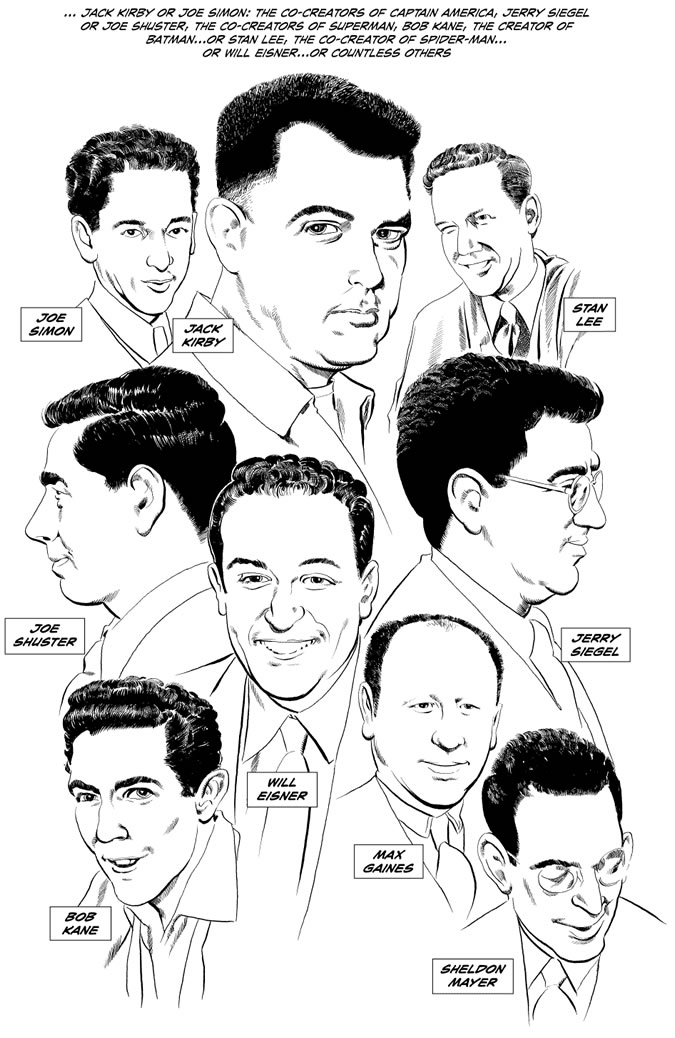
Your book reminded me of how Jews were hated over the centuries. I never could figure out why until I read history. My memories of the Jewish people from the early part of the Twentieth Century are of the contributions they have made. As your splendid illustration of the early comic book creators pointed out, there would not have been the great comic book industry as we know it today had the likes of them perished. 

Having been born in 1921 I have memories of the wonderful Jewish entertainers who were on the vaudeville stage and then into movies, the first talking picture with Al Jolson. I think of Irving Berlin who wrote over 1,000 songs including "White Christmas" and songwriters of Broadway musical comedies and then into movies. Their songs will live forever. I remember the great comedy writers, Neil Simon, Carl Reiner, Mel Brooks, Woody Allen, and the actors who they wrote for, Sid Caesar, Danny Kaye, Jerry Lewis of Martin and Lewis and countless others who made us laugh including a friend of Joe and mine Milton Berle and personal friend Morey Amsterdam. And how about my cousin Frank of Wayne and Shuster? Without his daughter Rosie and her then husband Lorne Micheals, there would not have been a SATURDAY NIGHT LIVE and all the actors who had their first showcases in the bigtime on that program. There would not have been of science like Albert Einstein or Carl Sagan.

We can imagine the losses of the Jews had not started the movie industry. We cannot typecast all the Jews to be the same when among them are the quiet, gentle, or funny artistic, musical creative Jews and the sharp, aggressive, greedy ones who take advantage of others. As Martin Luther King, Jr. said, "A man should not be judged by their skin color, race or religion but by their character."
Judenhass (2008)
Art by Dave Sim
Reading your book JUDENHASS and looking at the illustrations it set me to thinking about where did all this hatred come from. As a student of history I recall reading that about 2,000 years ago the Jew Saul had an illumination that the Rabbi Jesus was the Messiah the Jews had been waiting for. Saul became St. Paul and set about enlarging his cult group by converting everyone to become a Christian. Many Jews converted. Some did not. The Jews that did not convert gave their reason that their scrolls and books promised that their Messiah would free them from Roman tyranny. They could not accept Jesus as their Lord and Savior. That made the new Christians angry. They called them names and said terrible things about them. The hatred of the non-converters was passed down from generation to generation with exaggerated stories and distortions. Your book even pointed out that the Jews were accused of kidnapping Christian children and drinking their blood at their Sedar. No wonder the Jews became so hated. They were made to sound like evil devils. It is easy to believe a lie when it is repeated over and over again over the centuries. Anti-Semitism became the custom as generations of people believed the lies that had been written about them. Molly Goldberg in her early radio show said, "We don't want to rule the world. We just want to be allowed to live in it."

A 1994 book gives a good history of global hate of the Jews. It is called THE SECRET WAR AGAINST THE JEWS by John Loftus and Mark Aarons. Very important to understanding what led to the Holocaust.

The Holocaust was a demonstration of what hate could do. I would hope that Christians would take heed of the Messiah's messages as written in The New Testament. His loving words are spread throughout the Bible. He said, "Love thine enemies. Do good to them that hate you. Love one another as I have loved you. Love thy neighbor. Turn the other cheek. Judge not that ye be not judged. As ye do unto the least of these, my brethren, ye have done it unto me." Jesus was a peacemaker, not as we find today in public office in the U.S.A.

Let's hope our world going into the 21st century is moving into a higher consciousness. Just as Jerry Siegel and Joe Shuster were searching for truth and justice through their hero SUPERMAN as do other artists and writers expressing themselves through their heroes, so I hope mankind will become more Christ-like and do good for the sake of goodness as some of our comic book heroes are portrayed. Let's all be good for God's sake.

Love from the Joe Shuster family,
Jean, Dawn, & Warren

Jean Shuster Peavy is the youngest sister of Joe Shuster, the co-creator of Superman.

Tuesday, April 2, 2013

It Could Have Been...

Judenhass (2008)
Art by Dave Sim
STEPHEN HOLLAND:
(from Comics International #207, 2008)
Literally translated as "Jew Hatred", Judenhass' release coincides with the 60th Anniversary of the founding of the state of Israel. On the dedicated website, Sim writes, “I decided some time ago that the term Anti-Semitism… is completely inadequate to the abhorrent cultural phenomenon which it attempts to describe… It seemed to me that the term [Judenhass] served to distil the ancient problem to its essence, and in such a way as to hopefully allow other non-Jews (like myself) to see the problem “unlaundered” and through fresh eyes. Europe and various other jurisdictions aren’t experiencing a sudden upsurge in “Anti-Semitism”. What they are experiencing is an upsurge in Judenhass.”

The pages depicting the Holocaust or Shoah – the bleak barracks of Auschwitz in their full, freezing horror, and the gaunt faces of their skeletal occupants crammed onto stacks of hard, wooden racks – are accompanied by a calm, considered explanation of why Sim believes that every creative person should consider embarking on such a work, particularly those who aren’t Jewish:

““Lest we forget”… “Never again”… are fine and noble-sounding sentiments which have attached themselves to the historical remembrance of what was done to these innocent individuals and millions of others like them. But it seems to me that the words are largely meaningless if (as has been the case to now) in movies, in books, in plays and in documents of the historical record they are expressions largely if not exclusively being enunciated by Jews. If there is a chance of systemic Jew Hatred being eliminated from our society, it can’t just be Jews who speak out against it.”

Some things bear repeating, because some things do not bear being repeated.

He also points out that but for “geographical happenstance” the comicbook field “created, developed and built primarily by Jews, painstakingly, one comicbook at a time” could have lost Joe Simon, Jack Kirby, Stan Lee, Joe Shuster, Jerry Siegel, Will Eisner, Bob Kane, Max Gaines or Sheldon Mayer.

That’s precisely what Joe Kubert set out to explore in Yossel, published in 2003. Joe moved to America with his Jewish parents and sister when he was only a couple of months old, despite them being rebuffed earlier when his mother was pregnant. In Yossel, Joe puts himself in the place of a boy who hadn’t left Poland before its Nazi occupation. What follows is forced evacuation, incarceration, starvation and a systematic deprivation of comforts, communication, heating and clothes – a freezing endurance test without either hope or respite – and then it gets worse.

Kubert was one of the select few sent early copies of Judenhass and who have lined up to praise it, including Jean Shuster Peavy (Joe Shuster’s sister) and Marv Wolfman. Neil Gaiman wrote: “Judenhass is an astonishing piece of work. Painful and real and unflinching. I don't remember the last comic I read that made me cry, but this did." Indeed visitors to the Judenhass website should be warned, if only for parental guidance, that the animated introduction with its haunting soundtrack and terrible, echoing cracks of gunfire is as profoundly harrowing as the on-site preview.

The website also acts as a compendium to the comic, providing background research, some shockingly Anti-Semitic screeds from unexpected sources, and essays on the production process. In one of those Sim talks about the effect his detailed portraiture had on himself:
"At least temporarily I was able to individualize the victims for myself, personally, to differentiate each one as much as possible back into the individual he or she had been before the catastrophe of the Shoah had overtaken him or her."
"My people did this. That is, all of these individual Jews, all of these individual human beings, none of them very old, most in the prime of life came to the state in which I was capturing their likenesses through the actions of the non-Jews like myself. To set myself the task of capturing likenesses and expressions meant that I couldn't look away or see the Shoah through distanced overview, impersonally. How could I? Each death had been experienced personally, each death had been individual, each death had ended in a final eloquent...and horrific... expression. The only thing to me more horrific than those final expressions was the all-too-human urge to look away."
"How dare I? How dare any of us?"
Stephen Holland is the co-founder (with Mark Simpson) of one the UK's leading comic stores - Page 45.

Tuesday, January 15, 2013

The Making Of Judenhass

Judenhass (2008)
Art by Dave Sim
(Click Image To Enlarge)
DAVE SIM:
(ComicsComics, 3 February 2011)
Lou Copeland, who did the "tech" side of Judenhass, forwarded me a printed out copy of this article, which I found interesting enough to violate my acquiesced-to pariah status... since the genesis of Judenhass was structural along the lines of what Mr. McCulloch is discussing in his article, originating late in the Cerebus storyline with what I would describe as "Excerpt narrative". The idea being that you have a master drawing of some intricacy and detail from which you excerpt images. If you excerpt the images in (there's really no language for this yet) "sequential adjacency" from left to right across the master drawing, you effectively are doing a "pan shot". The extent of the overlap determines the "speed" of the pan shot.

The subject matter - the Shoah - came late in the proceedings. I was looking for a subject which lent itself to this sort of "master drawing"; "excerpt narrative"; "sequential adjacency" approach, but the original idea was: how few master drawings would you need to do in order to produce a satisfying "read"? The fewer the master drawings, the more time could be devoted to each one and the greater the level of photographic detail that could be applied to each image.

Close-ups presented an obvious problem because if you just enlarge an image past, say 120% then the density of the lines became incompatible with the adjacent images. This increased the number of master drawings. Any enlargement at 150% or larger need to be traced off and re-inked at the appropriate density. Or enlarged as a photocopy with the then "too thick" lines whites out and replaced with lines of an appropriate density.

I experimented with the structure again with the mini comic Lost Kisses #11, using a half dozen or so master drawings to create 40 or so individual panels.

The biggest drawback is the computer time involved which is why I don't use it as much on glamourpuss as I originally intended. The process of cutting and pasting the individual panels, fitting them within panel borders, making all the panel gutters the same width... well that was Lou's part of it, so he can address the subject better than I can. If Judenhass was selling thousands of copies a month and I could pay Lou for all his time and work then I could start thinking of projects with similar structure. In a way it's unfortunate that I picked a subject that just rubs the comic book public the wrong way which has led to a "baby with the bathwater" loss of the structure which I think is a valuable tool and pretty close to what Mr. McCulloch is talking about here - cinema on paper, a kind of strange wedding of film, comics and animation.

I just want to write and draw, not run a sweat shop which is what I think would be involved to optimize the structure: a team of cut-and-paste guys able to do, say, 15 to 20 panels each a day on computer from thumbnail storyboards, with computer lettering and scripts which which indicated successive percentages of enlargement and reduction, pan shot measurements to establish durations and speed, backgrounds and figures dealt with separately and then integrated. I think you could definitely do a plausible Bernie Krigstein or Jim Steranko narrative that would LOOK drawn (because it would be drawn, just mechanically composed into pages) and, depending on how good your team was you could maybe do five or six pages a day, every panel of which would look like the master artist drew them. Because he or she would have.