Showing posts with label Interviews. Show all posts

Monday, April 22, 2013

Tom Spurgeon on 'Dave Sim: Conversations'

TOM SPURGEON:
(from The Comics Reporter, 27 March 2013)
My giant 1996 interview with Dave Sim that ran in The Comics Journal is in here. I don't own that interview, and Fantagraphics has a good relationship with the series of interview books with which this is a part. I hope I get to see it someday! At any rate, not a lot of my interviews are republished in this way, so I'm looking forward to seeing this interview myself. I remember doing that interview in a way that I don't remember doing a lot of the others I've done. I was in an apartment in the Ballard neighborhood in Seattle and at the end of our talk I told Sim, "I hope you feel that went well." And he said, "You mean you hope I think that went well." True story. He was very nice to me during that interview, though, and I liked the result. Those interview books are usually pretty entertaining.
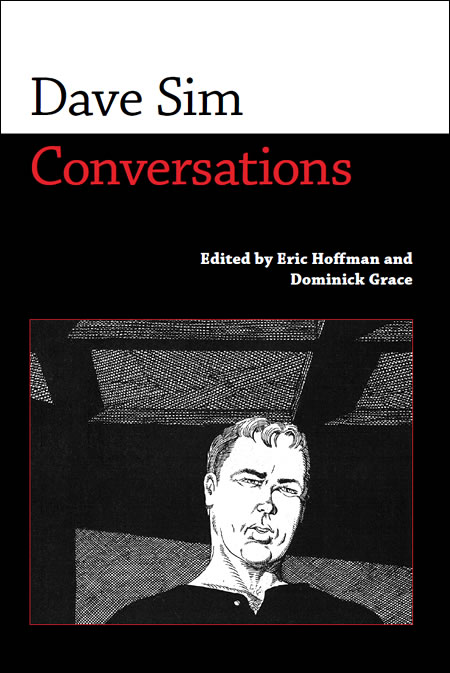
Dave Sim Conversations is published by University Press of Mississippi and available now from Amazon.com / Amazon.co.uk. Edited by Eric Hoffman and Dominick Grace, Dave Sim Conversations is a collection of interviews spanning 1982 to 2006. A complete list of the interviews included in the book can be found here. Go read Eric and Dominick's Q&A about the book.

Monday, April 8, 2013

Miriad

Miriad #5 (1981)
Art by Dave Sim
KEVIN DAVIES:
(from the interview introduction, Miriad #5, 1981)
Dave Sim has been steadily growing in popularity as both writer, artist and comics personality since the introduction of his own character and independent comic book Cerebus The Aardvark to the comics scene in December 1977. The comic itself acquired its title through a succession of events which more than reflect the trials encountered by any publication when first making an effort to establish a publishing operation. Dave produced his first drawing of the character on request from an acquaintance, Denise Loubert (now his wife), as a logo for her intended sword and sorcery fanzine. Once completed, the book was shipped to a printer in California, with neither money nor material heard from again. But the aardvark survived!

Realising the potential which could incorporate the Cerebus character within a sword and sorcery setting, Denise offered Dave her financial support and the two struck up a partnership. With Dave acting as creator and Deni (as she refers to herself), fulfilling the role of publisher, the two set out and produced the first three issue of Cerebus as a bi-monthly experimental probe of the market, testing whether there existed enough interest to justify the continued publication of an independent magazine of this sort. The response was overwhelming and the rest, to the delight of all, is a very eventful history.

(Thanks to Eddie Khanna for the Miriad scans!)

Saturday, March 9, 2013

Dave Sim Conversations

Dave Sim Conversations is published by University Press of Mississippi and available now from Amazon.com / Amazon.co.uk. Edited by Eric Hoffman and Dominick Grace, Dave Sim Conversations is a collection of interviews spanning 1982 to 2006. A complete list of the interviews included in the book can be found here. Eric and Dominick kindly forwarded the following Q&A they pre-prepared for UPM's publicity department.

What drew you to Dave Sim's work?

Dominick Grace:
Several things drew me to it. One is that, as a Canadian, I tend to want to check out work by Canadian talents, so Cerebus automatically was something I needed to try out, once I heard of it. I first heard of it in The Buyer's Guide for Comics Fandom (later renamed The Comics Buyers' Guide), which gave glowing reviews to early issues and, more importantly, ran the one-page Prince Valiant parody strips Sim did early on as a promotional tool. As a Hal Foster fan (Foster was another Canadian, incidentally), I was predisposed to like this strip, and Sim did a great job of affectionately skewering that classic strip. It was a short step from there to Swords of Cerebus volume one--another attractor was that Sim made the early issues available in such an inexpensive and accessible format--and the current issues of the comic; I got the first Swords volume and issues 13-17 (the then-current issue) all around the same time and was quickly won over mainly by Sim's humour and deadly parodic skills.

Eric Hoffman:
When I began reading Cerebus I was still quite young, 13 or so, and was mainly interested in superhero comics, notably Alan Moore, John Totleben and Stephen R. Bissette's Swamp Thing. An employee of the comic shop I frequented showed me an issue of Cerebus that included a Swamp Thing parody and I was immediately struck not only by the clever dialogue but also the overall weirdness of the work (in that issue, the character Cerebus, an anthropomorphic aardvark, is perched atop a floating mountain made almost entirely of carved faces spinning through space on some unknown trajectory while engaging in a conversation with a three-headed monstrosity composed of equal parts wizard, Swamp Thing and Marvel's Swamp Thing-esque Man-Thing). Also of note was the cover design, a simple photographic image of a moon, and the interior artwork, particularly the detailed line work of Sim's collaborator, Gerhard. It was quite unlike anything else I had seen - and this sometime after the height of the black and white comics explosion of the mid-1980s.

What makes Cerebus stand apart from other comic book works?

Dominick:
Several things make Cerebus stand apart. One of the most significant is its scope. Sim was way ahead of the curve on using comics to develop long, complex narratives that stood up well to (indeed, really demanded) rereading when major arcs were completed. Another, and perhaps the most significant one, is its graphic innovations. There are few cartoonists with so complete a command of the panel, the page, the sequence, the long narrative in comics form--even of often invisible elements of cartooning such as lettering. When Sim hit his stride, almost every issue of Cerebus was not only hugely entertaining but also a master class in how to do innovative, medium-expanding comics. Gerhard's contribution to this aspect of the book cannot be overestimated, by the way; his sophisticated command of spatial relations and masterly draughtsmanship ground the funny animal protagonist in a fully realized world.

Eric:
When I first read Cerebus, I became thoroughly addicted, as the work came out in mostly monthly doses with little to no break in continuity (moreover, the 100 or so issues that came out before I started reading it were available in collected format and in bi-weekly reprints). I continued to read Cerebus for several years until my interest in comics waned. When I came back to the comic some ten years later, the first thing that jumped out at me was how Sim and Gerhard's work had progressed, in particular Sim's skill as writer, letterer and caricaturist and Gerhard's layouts and detailed line work. Going back and reading the material I had missed - some one hundred issues - was absolutely enthralling and engrossing. I can't say that any other comic, which if it does last for any length of time regularly changes creative teams and dispenses with continuity whenever possible, provides a reader with a similar experience.

Where should readers new to Dave Sim's work begin their explorations?

Eric:
Personally, I think it's always best to begin at the beginning, with the first Cerebus volume. It generally gets short shrift among fans, and it has been customary for readers new to Cerebus to pick up the second volume, High Society. I've never understood this. For one, the first volume does contain what is now called "The Palnu Trilogy" which must be read first in order for High Society to make perfect sense. Also, the work does marvellously display Sim's stunningly vast improvement in skill as artist and writer (it covers just over three years' worth of work) and there are a number of plot points and characters introduced in this work that are crucial later in the series. Finally, the comic is a painfully amusing send-up of popular 1970s comic books, most notably Conan the Barbarian and Howard the Duck. Like much of Cerebus, it helps if you are familiar with what he is lampooning, but, like Carroll's Alice in Wonderland, is not necessary to enjoy the work.

Dominick:
Actually, I would recommend starting with High Society. It does suffer a bit from plot points carried over from  the first volume, but not so much that it should really impede reading, and its general level of accomplishment is much higher. Besides, now is  a good time to be getting it, what with IDW contracting with Sim to release a digital version including lots of extras.

Did you have to work much with Dave Sim on this project, and if so, how did he contribute?

Eric:
This collection developed organically out of the collection of essays I'd edited, Cerebus the Barbarian Messiah: Essays on the Epic Graphic Satire of Dave Sim and Gerhard. I'd originally contacted Sim to obtain rights for reprints for that book and he was quite willing to grant them, which is to be expected considering his view that anyone engaged in what can be considered a new, creative work does not require his direct permission. But I got it anyway (other publishers have different views than Sim). I'd long admired University Press of Mississippi's Conversations with Comics Artists series and wanted to build on the Barbarian Messiah book with a collection of interviews. Again, Sim was quite straightforward in granting rights to reprint images and so forth, but that was about the extent of his involvement in either of these books.

How did you go about selecting images to accompany the interview selections?

Eric:
Well, there were two ways, actually. Many of these interviews, notably the Spurgeon and Bernstein, were published with a number of images with reference to the topics being discussed. We decided to forgo many of these illustrations and to provide our own selections, in part to assert this book's autonomy and position as a largely new work despite nearly all of the content being otherwise previously available in some form or another (though most of it out of print). Primarily, we followed suit by choosing images we felt best illustrated a certain topic or theme being addressed in the interview. In some cases, we chose images simply because we had a particular preference for them; for example, Dominick was quite adamant that we include images of Mick and Keef, Sim's caricatures of Mick Jagger and Keith Richards.

Dominick:
I'd just add that, without trying to be programmatic about it, we tried to ensure that we produced images from across the run of the series, so that readers get to see samples of Sim and Gerhard's work from early on, from the middle of the run, and from late in the run. We ended up including images from most if not all of the individual collections.

Were there any interviews you wanted to include but could not?

Dominick:
One that leaps to mind is an early interview conducted for The Comics Journal, by Kim Thompson. It's a great, wide-ranging one, but also massive (as many Sim interviews are) and would have taken up a huge chunk of the available space. As it is, since interviews with Dave Sim do tend to be expansive, this book has fewer selections than some others in the Conversations series, so to include the Thompson one, we'd probably have had to cut two or three others. We opted instead to include only one, later Comics Journal interview, conducted by Tom Spurgeon shortly after the appearance of issue 186 of Cerebus and ranging extensively over Sim's career and grappling with his ideas. (The Comics Journal is, of course, one of the most consistent sources of insightful, expansive interviews with comics figures--perhaps the most consistent source--so it needed to be represented in our collection.)

Eric:
I for one would have liked to include some later interviews dealing with Sim's post-Cerebus work (notably Judenhass and glamourpuss) but as Dom says space was a concern and also the interviews included seem to have Cerebus as a natural focus, it being Sim's only major work and the bulk of his professional output to date. To include some of the later interviews, however fascinating, would have seemed a bit tacked on.

Why is a collection of Sim's interviews necessary? 

Dominick:
A collection of interviews is necessary, I think, because, like old floppies, these original records also often tended to disappear quickly into back issue bins, or oblivion. Comics and comics-related materials are often ephemeral. Many of the interviews we've included are inaccessible, or very hard to find, even for studious collectors--and even in these days of eBay. In a few cases (e.g. the Sandeep Atwal interview) the only reason we were able to include a piece at all is that we happened to have copies in our own collections, and in other cases, we had to rely on the great Margaret Liss, who probably has more Sim-related material than anyone else (visit her website at www.cerebusfangirl.com). And it's important, even essential, to look at these records because they present Sim in his own words. Given the controversies that dogged the latter years of his career, I think it's important to get back to his own explanations of his work and his ideas, rather than relying solely on what others have to say about him--which is often, to be frank, unfair to the work and to the man.

In what way has Sim's work changed the industry or the art form?

Dominick:
Sim made the graphic novel, as opposed to the floppy, the format of choice for comics, I'd argue. Pre-Cerebus, comics reprints were rare, and even rarer in book form--especially of new material,which in most instances was consigned to back issue bins within months (even weeks) of first appearing and had to be sought out and paid for through the nose, if you weren't lucky enough to be in on something when it started. I doubt we'd have the plethora of long serials designed to have clear endings, or the increasing number of original works produced at novel length, today without Sim's example.

Eric:
I'd add that without Sim's example such creators such as Frank Miller and Alan Moore would likely have continued working for the major publishers for a longer period of time and such works as From Hell and Sin City might have appeared in considerably different form.  Creator's rights would have been a more marginalized concern in the comics industry during the 1980s without Sim's presence as a viable self-publisher/alternative.  I'd say in part because of the example of Cerebus (there was also DC's well-publicized lawsuits over creative ownership of Superman, Jack Kirby's struggle to recover his original artwork from Marvel and Steve Gerber's lawsuit with Marvel over ownership of his character Howard the Duck), both DC and Marvel began to take creator's rights more seriously and to reconsider their very unfair and outdated contractual terms concerning restitution for creators - allowing creators to retain their rights, paying percentages as opposed to per-page pay rates, and so on.

What position do you believe Dave Sim occupies in the comic industry today?  Ultimately, what sort of legacy do you believe Sim has contributed to the comics field?

Dominick:
I think that the controversial nature of what Sim has had to say about feminism and to a lesser extent about religion has unfortunately marginalized him, at least to some extent. That said, many comics luminaries, both long-standing and more recently emerging, have acknowledged Sim's mastery of the medium (even when they object to Sim's ideology). He is recognized as a master of the comics form, though his influence is probably not as obvious as is that of some other comics masters. Certainly, one does not tend to see many Sim clones or imitators, as one has seen over the years with other figures, such as Neal Adams, Kirby, Eisner, and so on. Sim's more sui generis--a unique figure like Ditko, or Gene Colan--instantly recognizable, hard to imitate, but definitely foundational. In some ways, it's hard to imagine a figure more different from Sim than Chris Ware, for instance, but when I read Ware, I can't help thinking that his innovations with layout and format would have been unlikely without a precursor like Sim.

Eric:
I've already mentioned Sim's impact on creator's rights and certainly that has had a major impact not only on how comics creators publish and market their work but also on what kind of work creators choose to publish.  Cerebus is a long-form work ne plus ultra - there is literally nothing else like it in the discrete, monthly comic format (the closest form that comes to it is manga - a form with which Sim said he has little familiarity - and yet manga is designed to be read quickly and involves a more cinematic structure than its Western counterparts, most notably Cerebus which, with its many text interpolations, is a decidedly literary comic book).  Anything exceeding Cerebus' length is necessarily compromised by a variety of factors and always to the detriment of its tone, narrative structure and stability and even comprehension.  As Dom notes, the medium has somewhat regrettably shifted away from monthly comics as a viable publishing option for many creators and publishers -   the budgets are too tight and the work loads too demanding - in favor of graphic novels or longer collected works (and monthly comics are almost always written with an inevitable paperback collection of 6 or 10 issues in mind), so it is my feeling that, at least for the time being, Cerebus will remain an entirely unique work for its medium.

© University Press of Mississippi. Used with permission.

Saturday, February 16, 2013

Dave Sim Discusses 'The High Society Collection' Art Auction

When Dave Sim announced in early February that he was auctioning some of his original Cerebus art from High Society via Heritage Auctions, I was worried. In his essay The End?, which appeared in the final issue of Glamourpuss #26 in 2012, he had outlined a 'Doomsday Scenario' in which a combination of falling sales on the Cerebus graphic novels and little prospect of other paying comics work, would force him to liquidate Aardvark Vanaheim and seek work in the Alberta tar sands. Had things really got that bad for him? I immediately faxed Dave 10 questions seeking clarification, and in the answers below, Dave explains his motivation behind the current art auction, his prospects in the comics industry, and thoughts on preserving the Cerebus Archive.

The 10 pages of High Society artwork being auctioned are reproduced below, together with links to Heritage Auctions, where you can place your online bid until 21 February. Alternatively you can bid in person at the live auction being held on 22 February at the Fletcher-Sinclair Mansion, 2 East 79th Street, New York.
Cerebus #26 Page 10 - Cerebus #29 Page 9
A Moment Of Cerebus:
How did you select the 10 pages for The High Society Collection art auction?

Dave Sim:
I sent a copy of HIGH SOCIETY to Lon Allen, the consignment director at Heritage Auctions. A stand-up guy and early signer of the petition. Which blew me away. I only met him once when Pete Dixon brought him to town. Anyway, I sent him HS with all of the pages in the Cerebus Archive marked with a check mark in the upper right and left corners of the pages and asked him to list his preferences. Which he did.

Did you think these would be the most appealing to potential bidders, or were they just your least favourite pages?

Well, no, you can't really DO that: least favourite pages. Heritage is the third largest auction house in the WORLD right behind Christie's and Sotheby's and surging like crazy in the last year or so. Lon has years of expertise as to what sells and what doesn't -- not just good pages but pages that will look good on the catalogue page which is often -- but not always -- the same thing. Giving Heritage "least favourite" pages would be like going into the Stanley Cup finals, thinking, Well, let's just hang back and see how this goes. It's the Stanley Cup finals. You give it your absolute best. Like Mitch Williams (to mix a baseball metaphor in here) "I pitch like my hair's on fire."

What was the motive for the current auction? Are you just "testing the waters" of the original art market place, or is the auction part of your "Doomsday Scenario" as outlined in your essay The End? in glamourpuss #26?

Well, in a sense, when you're 57 years old in the comic-book field, everything is a Doomsday Scenario. I set this in motion by calling Lon and finding out if Heritage was interested, which they were. Very. So, that was very gratifying. But you have to start early. It's a long process of negotiation and I knew that would be the case. I set that in motion and then John and I did the Kickstarter campaign which didn't require AS early a start. It was successful but I guessed the money wouldn't last much past the end of the year with all the overhead and that was what happened. Lon and I weren't ready for the November auction which is what we originally planned. There was still some negotiating to do. But we were ready for the February auction. Lead time. Everything is lead time.
Cerebus #30 Page 13 - Cerebus #32 Page 16
Will you be selling any other pages in the foreseeable future, or is this it for a while?

I HOPE this is it, period.

In between winding up Kickstarter and moving the Heritage Auction along, Ted Adams at IDW -- another signatory to the petition, which is why I trust him implicitly -- sort of cautiously mentioned that they were doing MARS ATTACKS month and was I interested in doing a variant cover? My reputation -- which bears (and always has only borne) a vague resemblance to me -- precedes me. Everyone expects me to bite their head off whatever they're asking me. Heck, Ted, it sounds like fun. Is that really what they pay for covers these day? Wow. I was impressed.

A couple of weeks later, I thought, Maybe I'm being way too Rube Goldberg about this "how do I make a living in my fifties?" thing. Why not get basic and just do, say, four covers a month? So, I asked. Apprehensive that it would be, "Uh, no Dave -- just MARS ATTACKS, okay?" Letting me figure out for myself that I'm a) too old and b) completely out of fashion. No, not YET anyway. They had, like, 19 titles for me to pick from. Warning me away from the franchises that tend to want to micromanage the property.

And then a couple of weeks later it occurred to me: hey, what if I auction the covers through Heritage? That was one of the things Lon and I went around and around about. You want to BUILD a market for your work. Put a bunch of pages in the catalogue, fine, but they also do weekly auctions. Get buyers used to the pages turning up on an on-going basis. This ties in with your next question, so go ahead.
Would you prefer to hang onto all your original art, and if so, why? Once you have a high resolution scan, what is the merit in holding onto the original art? Do you see this as your pension fund to sell at a future date, or would you prefer to keep the Cerebus Archive as complete as possible as part of your "legacy"?

Well, "legacy" in quotation marks pretty much sums up the current status quo, but, yes. The essence of the Cerebus Archive is the original artwork. Like the Andy Warhol Museum. What's the point of the Andy Warhol Museum? The paintings and the prints. The pages aren't stored in the house but the house, all the contents of the house and the off-site storage are considered the Cerebus Archive. That's what I see as my job to preserve. MY work and OUR -- Ger's and my -- work. No scan can do justice to original artwork although the technology is getting better. I don't think it will EVER be as good as the original art.

When we had a number of pieces in the Norman Rockwell Museum's COMIC LIT show that toured for years, I went to the opening in Stockbridge. Rockwell signed a PILE of prints before he died and they're using those at least partly to buy paintings back. Which was very foresighted of him. You see behind the scenes: this is how you do this. You create currency that will appreciate over the years that you can use to get the work out of private hands and into the hands of those charged with preserving your -- in Rockwell's case -- LEGACY.

In other words, you don't build the Cerebus Archive by selling HIGH SOCIETY pages. But I'm at the low ebb of earnings potential because of...let me be diplomatic...the political climate. I'm pretty sure the climate will change:  you can't ignore the only 6,000 page graphic novel forever, I don't think but it has been ignored for twenty years and there's no sign of it being paid attention to. People love Rockwell. People hate Dave Sim. So, for me, it requires more of a process of pulling the wagons in a circle and keeping my powder dry. Keeping myself and CEREBUS from being destroyed in my lifetime and for as long after I'm dead as proves to be necessary. I think about it a lot. I'm making progress.

Finishing off your previous question: I realized, God willing I'm going to have 48 IDW covers a year to sell. So, that's the fall-back position: Lon gets a cover a week pretty much through 2013 for his weekly auctions. I don't own the images. It's work-made-for-hire. It's really just a way to practice and learn photorealism and stylized realism. Once it's done it's a lesson learned, percolating through me during the three weeks I'm writing THE STRANGE DEATH OF ALEX RAYMOND and then applied to the next batch of covers and (ultimately) to the STRANGE DEATH pages when I'm at the point of doing them full time. And -- potentially, anyway, we'll see how it goes -- it means I don't have to sell CEREBUS artwork or STRANGE DEATH artwork or glamourpuss pages.

But I have that option (in reverse order of preference) if the economy continues to just limp along.
Cerebus #36 Page 1 - Cerebus #39 Page 17
Have you ever regretted selling a piece of your original art?

At a specific level, I regret having sold ANY of it, which is why I try to structure things so I don't have to. I envy people who have ALL of their own work. I think Wendy Pini still has all of ELFQUEST. I think Jeff Smith still has ALL of BONE. The Walt Simonsen THOR book IDW did was only possible because he had all the artwork. Good for Walt! I wish I could say that about HIGH SOCIETY.

Is it that you feel a bond toward it, or could you care less about it once it's printed?

Well, as I say, it's off-site so it's not something that's -- with apologies to Burt Bacharach -- "always there to remind me". Personally, no, I don't have a bond with it. It's just bad art. Things I tried to do well and was successful with to... a degree. 75%-happy-with-it pages, 50%-happy-with-it-pages. Some 90% happy with it. Mostly 95% happy with what Gerhard did pages, which is a different thing. The best analogy I could come up with would be Barry Windsor-Smith and "Red Nails". Barry isn't happy with it. It's like, "I know how to do all that much better now." The proportions are off. All you can see are the flaws that you couldn't see when you originally did it. But I saw it when I was 17 so I'll always see it as a 17-year-old would see it. "THIS IS BLOWING. MY. MIND." But to Barry it's just bad Barry art.

But, yes, definitely -- it's the work he's most known for in comics. For me, there should be a Gorblimey Museum or a promise of a Gorblimey Museum where you can go and see all of "Red Nails" on the wall. Or rotating 10 pages at a time. And that isn't going to happen. "Red Nails" was purchased in its entirety. So, it's in private hands. That means only one lucky guy gets to see it. Well, CEREBUS and HIGH SOCIETY are my "Red Nails" and I know that. You have to be able to stand back far enough to see what everyone else sees the way they see it and be... responsible... towards that. If I sold all of the CEREBUS artwork and STRANGE DEATH artwork and hung onto the glamourpuss pages -- my personal preference -- posterity would take a dim view. Like Lewis Carroll annotating thoroughly all of his treatises on mathematics and preserving the material. Get a grip. ALICE IN WONDERLAND and THROUGH THE LOOKING GLASS. That's what people want.

The political climate I referred to is at its worst in Kitchener. On top of which even the people who know what I did look down on it. Not with any animosity. It's just a comic book. Weird thing to do for a living. I know the guy who pretty much runs Heritage Kitchener. I know the Mayor. It's just not something we could have a conversation about. So, preserving it to a future day when that... POSSIBLY... isn't the case is a pretty much insurmountable task. But, then so was producing it in the first place, right? One example of insurmountable follows another. As Scott Fitzgerald wrote in his notebooks, "Learn young about hard work and good manners and you'll be through the whole nasty business and nicely dead again before you know it."

It came as an enormous surprise to me that I still had 190 pages of HIGH SOCIETY when I had to go and get them for Sandeep to scan. Just a PILE of artwork. I thought it was like CEREBUS where I have maybe two dozen. That was what made me think: Well, okay, you've got about 170 pages more than you thought you did. It's a good representation. What's 10 pages going to hurt?  It was a very unhappy first step though.
Cerebus #44 Page 1 - Cerebus #50 Page 1
Are there any pages/illustrations you absolutely would never sell?  If so, which and why?

Never say never. Another massive hit to the global economy like September 2008 and I could be trading HIGH SOCIETY pages for loaves of bread in my 70s and 80s.

I think you mentioned during HARDtalk interview / HARDtalk Tour that Gerhard still had an ownership interest in his Cerebus art. Does this factor into your selling timetable at all, or do you control when/where it sells?

It factored into the decision to do HIGH SOCIETY pages. Those pages are mine so I have control there of when/where it sells.

For tax reasons, the artwork is considered the property of Aardvark-Vanaheim and is valued based on the raw materials that went into it which Aardvark-Vanaheim paid for. So, basically $5 worth of illustration board, ink, tone, border tapes, etc. When I bought Gerhard's 40% of the company, we basically did "one for me, one for you" on paper. We both have a complete inventory of the artwork with every other listed page highlighted in yellow. It was a way of avoiding trade-offs -- oh, I wanted THIS page or I'll trade you all of THIS issue for all of THAT issue. I forget if Gerhard has the yellow pages or I do. The idea is if someone wants to make an offer on a page or cover, he or she makes it to whoever has "jurisdiction" over that page or cover. The "jursidication" guy says a) okay, it's yours.  b) he gets paid and c) he pays the other guy whatever he considers a fair share of the offered price (bearing in mind that he'll be on the other end of that if the other guy sells a page). We did that with a few covers that Gerhard had jurisdiction over -- wide range of prices, to establish the principle: these don't have a fixed value until someone makes a solid offer. Ger looked at what I had done and paid me what he thought my part was worth on THAT cover. That's the way it's stood since 2006. I haven't sold anything I have jurisdiction over and neither has Ger. We're both old enough to think "You know, I will probably live to see the $20 loaf of bread and the $40 jug of milk." 


Have you kept a scan/photocopy of all the non-'comic page' illustrations you do? I'm sensing the potential for an ART OF DAVE SIM book from IDW after the CEREBUS COVERS books.

It would be nice to think. Like I say, people love Norman Rockwell and people hate Dave Sim. That's going to be reflected in the level of interest for however long that proves to be the case. Could be "all better" now, could be booming like a skyrocket -- everyone loves me or loves my work, could be tanking -- Dave who? Chris Ryall, the editor-in-chief,  really likes the covers I'm doing for IDW. REALLY likes the covers I'm doing for IDW. Right now, that's the middle of the circle around which I have my metaphorical wagons. I really don't want to do anything with IDW which has the potential of them saying "WTF?" when they look at the sales figures. The impression is that the COVERS books will do land-office business. If they DON'T do land-office business, I'll still have my cover rate and whatever I can make from Heritage auctioning them. It's buying me time to do THE STRANGE DEATH OF ALEX RAYMOND. I really can't ask for more than that.

The prices on the HIGH SOCIETY pages are already about as high as I thought they would end up, so there IS cause for optimism. I can't even guess which page will go for the most. But, that's what makes horse races.

Bottom line: if the covers deal with IDW maintains itself and they hit a certain price point in the Heritage Auctions, yes, these will be the LAST "High Society Collection" pages you will be seeing.
Now, YOU guess what that means. :)

Own a piece of Cerebus! Dave Sim's High Society Collection of original Cerebus art is being auctioned by Heritage Auctions. You can place your online bid until 21 February or bid in person at the live auction being held on 22 February at the Fletcher-Sinclair Mansion, 2 East 79th Street, New York. The pages being auctioned are: