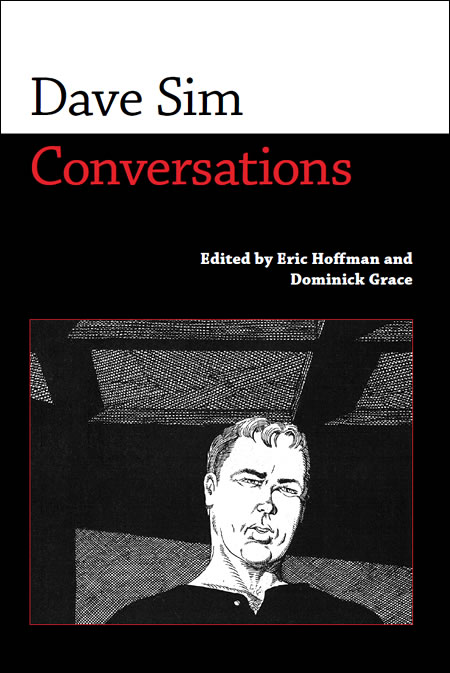
Dave Sim Conversations is published by University Press of Mississippi and available now from Amazon.com / Amazon.co.uk. Edited by Eric Hoffman and Dominick Grace, Dave Sim Conversations is a collection of interviews spanning 1982 to 2006. A complete list of the interviews included in the book can be found here. Eric and Dominick kindly forwarded the following Q&A they pre-prepared for UPM's publicity department.
What drew you to Dave Sim's work?
Dominick Grace:
Several things drew me to it. One is that, as a Canadian, I tend to want to check out work by Canadian talents, so Cerebus automatically was something I needed to try out, once I heard of it. I first heard of it in The Buyer's Guide for Comics Fandom (later renamed The Comics Buyers' Guide), which gave glowing reviews to early issues and, more importantly, ran the one-page Prince Valiant parody strips Sim did early on as a promotional tool. As a Hal Foster fan (Foster was another Canadian, incidentally), I was predisposed to like this strip, and Sim did a great job of affectionately skewering that classic strip. It was a short step from there to Swords of Cerebus volume one--another attractor was that Sim made the early issues available in such an inexpensive and accessible format--and the current issues of the comic; I got the first Swords volume and issues 13-17 (the then-current issue) all around the same time and was quickly won over mainly by Sim's humour and deadly parodic skills.
Eric Hoffman:
When I began reading Cerebus I was still quite young, 13 or so, and was mainly interested in superhero comics, notably Alan Moore, John Totleben and Stephen R. Bissette's Swamp Thing. An employee of the comic shop I frequented showed me an issue of Cerebus that included a Swamp Thing parody and I was immediately struck not only by the clever dialogue but also the overall weirdness of the work (in that issue, the character Cerebus, an anthropomorphic aardvark, is perched atop a floating mountain made almost entirely of carved faces spinning through space on some unknown trajectory while engaging in a conversation with a three-headed monstrosity composed of equal parts wizard, Swamp Thing and Marvel's Swamp Thing-esque Man-Thing). Also of note was the cover design, a simple photographic image of a moon, and the interior artwork, particularly the detailed line work of Sim's collaborator, Gerhard. It was quite unlike anything else I had seen - and this sometime after the height of the black and white comics explosion of the mid-1980s.
What makes Cerebus stand apart from other comic book works?
Dominick:
Several things make Cerebus stand apart. One of the most significant is its scope. Sim was way ahead of the curve on using comics to develop long, complex narratives that stood up well to (indeed, really demanded) rereading when major arcs were completed. Another, and perhaps the most significant one, is its graphic innovations. There are few cartoonists with so complete a command of the panel, the page, the sequence, the long narrative in comics form--even of often invisible elements of cartooning such as lettering. When Sim hit his stride, almost every issue of Cerebus was not only hugely entertaining but also a master class in how to do innovative, medium-expanding comics. Gerhard's contribution to this aspect of the book cannot be overestimated, by the way; his sophisticated command of spatial relations and masterly draughtsmanship ground the funny animal protagonist in a fully realized world.
Eric:
When I first read Cerebus, I became thoroughly addicted, as the work came out in mostly monthly doses with little to no break in continuity (moreover, the 100 or so issues that came out before I started reading it were available in collected format and in bi-weekly reprints). I continued to read Cerebus for several years until my interest in comics waned. When I came back to the comic some ten years later, the first thing that jumped out at me was how Sim and Gerhard's work had progressed, in particular Sim's skill as writer, letterer and caricaturist and Gerhard's layouts and detailed line work. Going back and reading the material I had missed - some one hundred issues - was absolutely enthralling and engrossing. I can't say that any other comic, which if it does last for any length of time regularly changes creative teams and dispenses with continuity whenever possible, provides a reader with a similar experience.
Where should readers new to Dave Sim's work begin their explorations?
Eric:
Personally, I think it's always best to begin at the beginning, with the first Cerebus volume. It generally gets short shrift among fans, and it has been customary for readers new to Cerebus to pick up the second volume, High Society. I've never understood this. For one, the first volume does contain what is now called "The Palnu Trilogy" which must be read first in order for High Society to make perfect sense. Also, the work does marvellously display Sim's stunningly vast improvement in skill as artist and writer (it covers just over three years' worth of work) and there are a number of plot points and characters introduced in this work that are crucial later in the series. Finally, the comic is a painfully amusing send-up of popular 1970s comic books, most notably Conan the Barbarian and Howard the Duck. Like much of Cerebus, it helps if you are familiar with what he is lampooning, but, like Carroll's Alice in Wonderland, is not necessary to enjoy the work.
Dominick:
Actually, I would recommend starting with High Society. It does suffer a bit from plot points carried over from the first volume, but not so much that it should really impede reading, and its general level of accomplishment is much higher. Besides, now is a good time to be getting it, what with IDW contracting with Sim to release a digital version including lots of extras.
Did you have to work much with Dave Sim on this project, and if so, how did he contribute?
Eric:
This collection developed organically out of the collection of essays I'd edited,
Cerebus the Barbarian Messiah: Essays on the Epic Graphic Satire of Dave Sim and Gerhard. I'd originally contacted Sim to obtain rights for reprints for that book and he was quite willing to grant them, which is to be expected considering his view that anyone engaged in what can be considered a new, creative work does not require his direct permission. But I got it anyway (other publishers have different views than Sim). I'd long admired University Press of Mississippi's
Conversations with Comics Artists series and wanted to build on the
Barbarian Messiah book with a collection of interviews. Again, Sim was quite straightforward in granting rights to reprint images and so forth, but that was about the extent of his involvement in either of these books.
How did you go about selecting images to accompany the interview selections?
Eric:
Well, there were two ways, actually. Many of these interviews, notably the Spurgeon and Bernstein, were published with a number of images with reference to the topics being discussed. We decided to forgo many of these illustrations and to provide our own selections, in part to assert this book's autonomy and position as a largely new work despite nearly all of the content being otherwise previously available in some form or another (though most of it out of print). Primarily, we followed suit by choosing images we felt best illustrated a certain topic or theme being addressed in the interview. In some cases, we chose images simply because we had a particular preference for them; for example, Dominick was quite adamant that we include images of Mick and Keef, Sim's caricatures of Mick Jagger and Keith Richards.
Dominick:
I'd just add that, without trying to be programmatic about it, we tried to ensure that we produced images from across the run of the series, so that readers get to see samples of Sim and Gerhard's work from early on, from the middle of the run, and from late in the run. We ended up including images from most if not all of the individual collections.
Were there any interviews you wanted to include but could not?
Dominick:
One that leaps to mind is an early interview conducted for
The Comics Journal, by Kim Thompson. It's a great, wide-ranging one, but also massive (as many Sim interviews are) and would have taken up a huge chunk of the available space. As it is, since interviews with Dave Sim do tend to be expansive, this book has fewer selections than some others in the
Conversations series, so to include the Thompson one, we'd probably have had to cut two or three others. We opted instead to include only one, later C
omics Journal interview, conducted by Tom Spurgeon shortly after the appearance of issue 186 of
Cerebus and ranging extensively over Sim's career and grappling with his ideas. (
The Comics Journal is, of course, one of the most consistent sources of insightful, expansive interviews with comics figures--perhaps the most consistent source--so it needed to be represented in our collection.)
Eric:
I for one would have liked to include some later interviews dealing with Sim's post-
Cerebus work (notably
Judenhass and
glamourpuss) but as Dom says space was a concern and also the interviews included seem to have
Cerebus as a natural focus, it being Sim's only major work and the bulk of his professional output to date. To include some of the later interviews, however fascinating, would have seemed a bit tacked on.
Why is a collection of Sim's interviews necessary?
Dominick:
A collection of interviews is necessary, I think, because, like old floppies, these original records also often tended to disappear quickly into back issue bins, or oblivion. Comics and comics-related materials are often ephemeral. Many of the interviews we've included are inaccessible, or very hard to find, even for studious collectors--and even in these days of eBay. In a few cases (e.g. the Sandeep Atwal interview) the only reason we were able to include a piece at all is that we happened to have copies in our own collections, and in other cases, we had to rely on the great Margaret Liss, who probably has more Sim-related material than anyone else (visit her website at
www.cerebusfangirl.com). And it's important, even essential, to look at these records because they present Sim in his own words. Given the controversies that dogged the latter years of his career, I think it's important to get back to his own explanations of his work and his ideas, rather than relying solely on what others have to say about him--which is often, to be frank, unfair to the work and to the man.
In what way has Sim's work changed the industry or the art form?
Dominick:
Sim made the graphic novel, as opposed to the floppy, the format of choice for comics, I'd argue. Pre-
Cerebus, comics reprints were rare, and even rarer in book form--especially of new material,which in most instances was consigned to back issue bins within months (even weeks) of first appearing and had to be sought out and paid for through the nose, if you weren't lucky enough to be in on something when it started. I doubt we'd have the plethora of long serials designed to have clear endings, or the increasing number of original works produced at novel length, today without Sim's example.
Eric:
I'd add that without Sim's example such creators such as Frank Miller and Alan Moore would likely have continued working for the major publishers for a longer period of time and such works as From Hell and Sin City might have appeared in considerably different form. Creator's rights would have been a more marginalized concern in the comics industry during the 1980s without Sim's presence as a viable self-publisher/alternative. I'd say in part because of the example of Cerebus (there was also DC's well-publicized lawsuits over creative ownership of Superman, Jack Kirby's struggle to recover his original artwork from Marvel and Steve Gerber's lawsuit with Marvel over ownership of his character Howard the Duck), both DC and Marvel began to take creator's rights more seriously and to reconsider their very unfair and outdated contractual terms concerning restitution for creators - allowing creators to retain their rights, paying percentages as opposed to per-page pay rates, and so on.
What position do you believe Dave Sim occupies in the comic industry today? Ultimately, what sort of legacy do you believe Sim has contributed to the comics field?
Dominick:
I think that the controversial nature of what Sim has had to say about feminism and to a lesser extent about religion has unfortunately marginalized him, at least to some extent. That said, many comics luminaries, both long-standing and more recently emerging, have acknowledged Sim's mastery of the medium (even when they object to Sim's ideology). He is recognized as a master of the comics form, though his influence is probably not as obvious as is that of some other comics masters. Certainly, one does not tend to see many Sim clones or imitators, as one has seen over the years with other figures, such as Neal Adams, Kirby, Eisner, and so on. Sim's more sui generis--a unique figure like Ditko, or Gene Colan--instantly recognizable, hard to imitate, but definitely foundational. In some ways, it's hard to imagine a figure more different from Sim than Chris Ware, for instance, but when I read Ware, I can't help thinking that his innovations with layout and format would have been unlikely without a precursor like Sim.
Eric:
I've already mentioned Sim's impact on creator's rights and certainly that has had a major impact not only on how comics creators publish and market their work but also on what kind of work creators choose to publish. Cerebus is a long-form work ne plus ultra - there is literally nothing else like it in the discrete, monthly comic format (the closest form that comes to it is manga - a form with which Sim said he has little familiarity - and yet manga is designed to be read quickly and involves a more cinematic structure than its Western counterparts, most notably Cerebus which, with its many text interpolations, is a decidedly literary comic book). Anything exceeding Cerebus' length is necessarily compromised by a variety of factors and always to the detriment of its tone, narrative structure and stability and even comprehension. As Dom notes, the medium has somewhat regrettably shifted away from monthly comics as a viable publishing option for many creators and publishers - the budgets are too tight and the work loads too demanding - in favor of graphic novels or longer collected works (and monthly comics are almost always written with an inevitable paperback collection of 6 or 10 issues in mind), so it is my feeling that, at least for the time being, Cerebus will remain an entirely unique work for its medium.
© University Press of Mississippi. Used with permission.